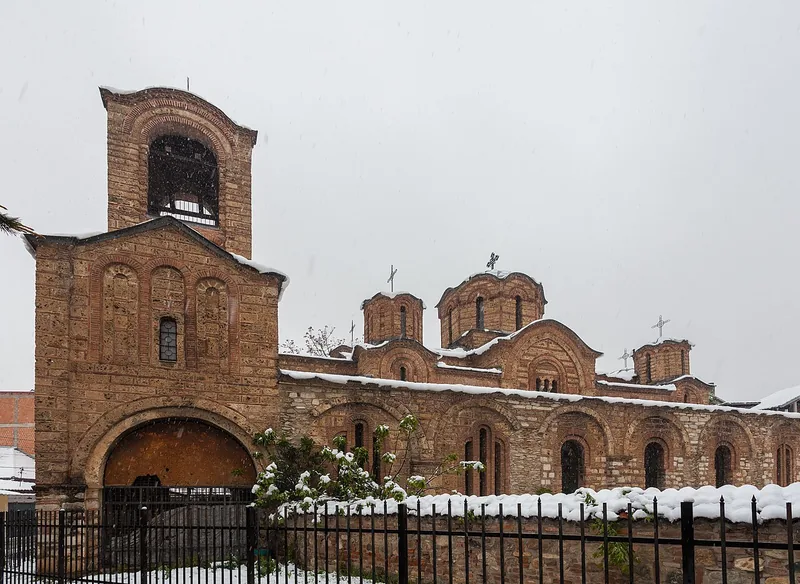
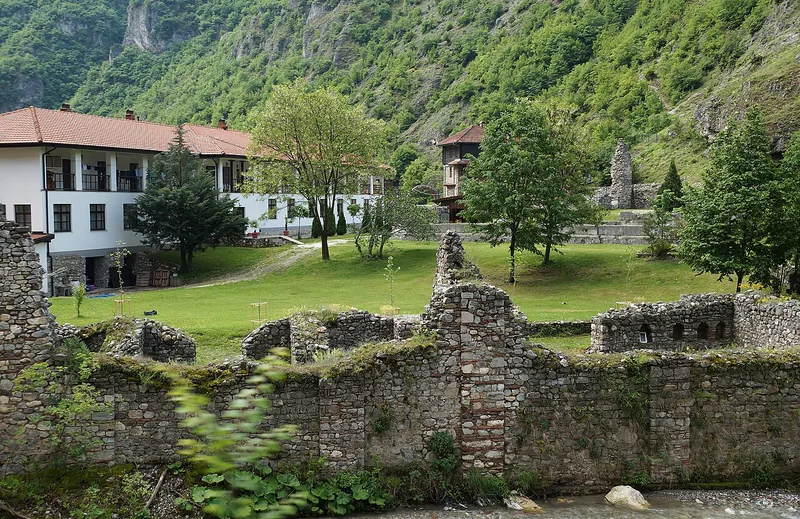
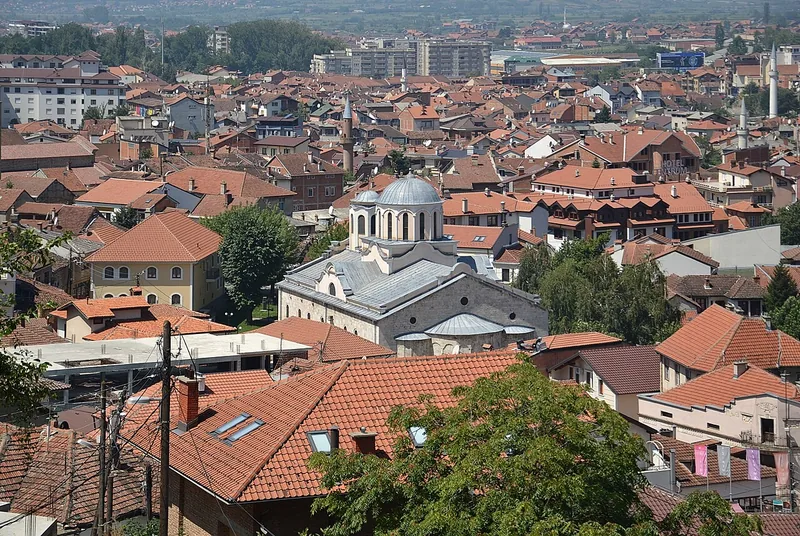
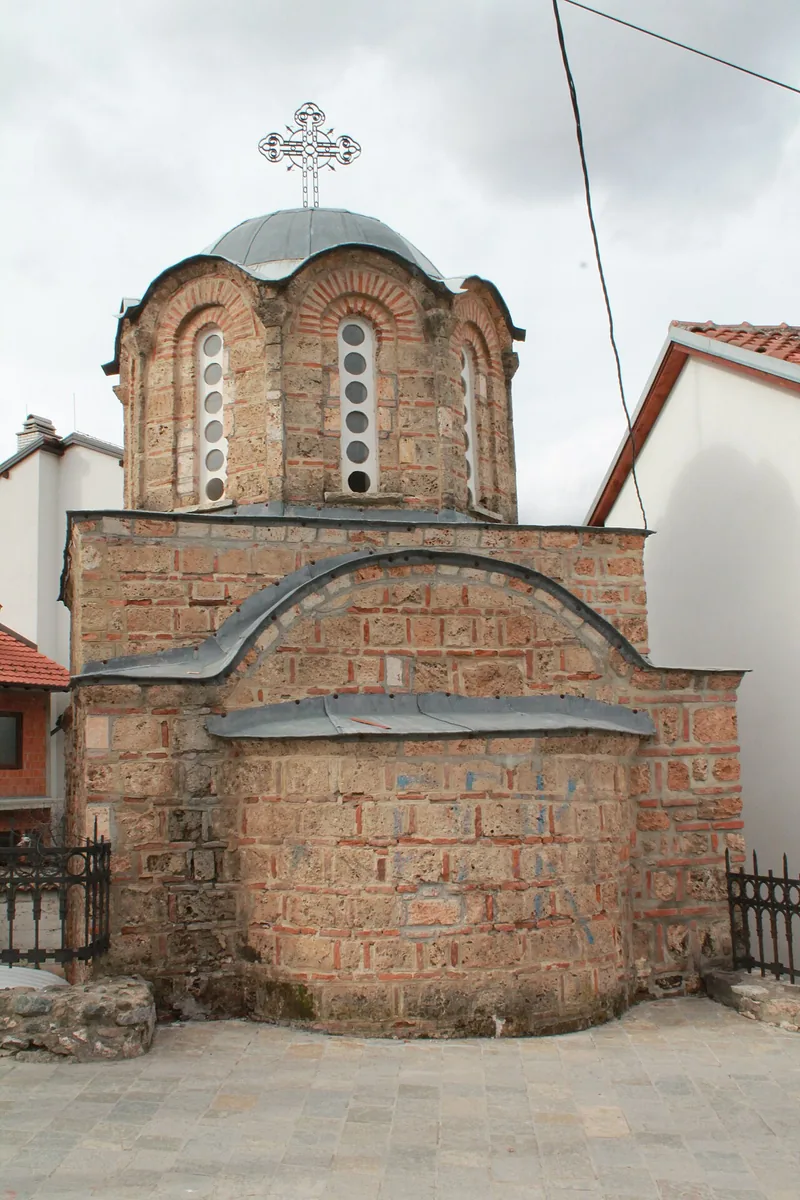
The Church of the Holy Saviour (Crkva Svetog Spasa, dedicated to the Ascension of Christ) stands on an elevated terrace in the historic Potkaljaja quarter on the northern slope beneath Prizren Fortress. Built around 1330 as the endowment of Serbian nobleman Mladen Vladojević, the monument features a distinctive architectural configuration: a 14th-century single-aisled domed church enclosed within the stone perimeter walls and belfry of an unfinished 19th-century church. Listed as #06 in the RIC catalogue, its May 2009 dossier documents March 2004 fire damage, 2005 protective works, and a programmed 2009 UNESCO intervention.

Historical and Architectural Significance
Built in the first half of the 14th century (around 1330) on a prominent spur in the Potkaljaja neighborhood overlooking Prizren, the Church of the Holy Saviour was founded by the Serbian nobleman Mladen Vladojević and his family. In Emperor Stefan Dušan's 1348 founding charter for the Holy Archangels Monastery, Mladen Vladojević's church and its estates were confirmed as a metochion (dependency) of the imperial monastery. In the archived dossier of the Reconstruction Implementation Commission (RIC) under entry #06, the medieval core is described as a Late Byzantine one-aisled domed church with a cross-vaulted pronaos (narthex) and surviving 14th-century wall paintings.
The distinctive visual and spatial character of the monument stems from an ambitious expansion begun in 1836, when the local Orthodox community started building a large three-aisled church with a western bell tower around the medieval chapel, intending to incorporate the 14th-century structure as a southern lateral chapel. Because the 19th-century construction was never roofed or vaulted, its high stone walls remained open to the sky, forming a walled courtyard (atrium) enclosing the medieval church—as concisely noted in the RIC dossier: Walls from an unfinished newer church form the church yard.
The 14th-century church is constructed in refined Late Byzantine cloisonné masonry of alternating tufa stone and brick courses, richly ornamented with ceramoplastic patterns on its octagonal dome drum and three-sided apse. Its interior preserves two precious layers of 14th-century Palaiologan frescoes in the sanctuary, nave, and narthex, which underwent extensive architectural and pictorial conservation between 1953 and 1963.
Destruction and Recorded Damage (March 2004)
In its 2004-Damage Assessment section, the archived RIC dossier carefully distinguishes the damage caused during the March 2004 riots across the two architectural components of the site: (1) the Older church (14th century) and (2) the Newer church walls (19th century) and bell tower.
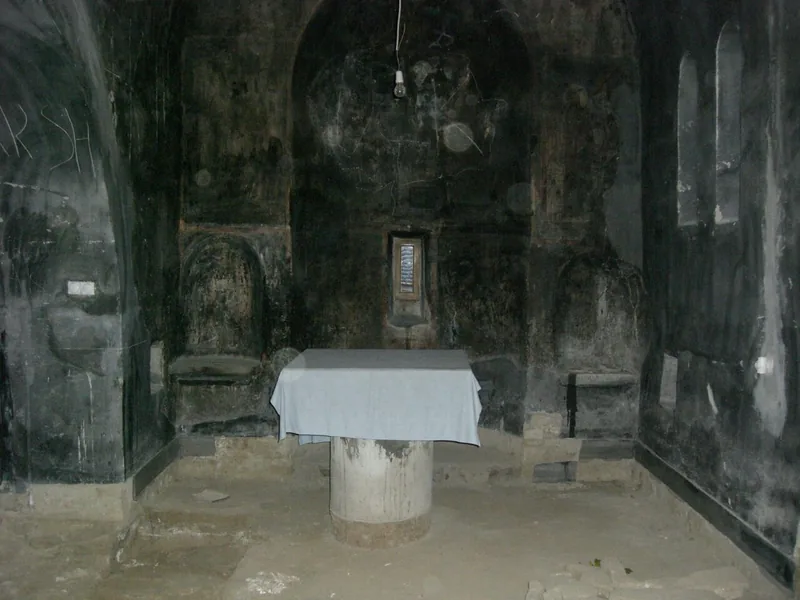
For the older 14th-century church, the RIC assessment notes that while the exterior remained in good condition, the interior was damaged by fire, which affected the internal wall surfaces, medieval wall paintings, stone floor, and wooden doors and windows. For the walls of the newer 19th-century unfinished church, the assessment records that the stonework was heavily soiled by smoke, the upper wall sections had become structurally unstable, doors and windows were affected by fire, and the bell tower was left in an unstable condition.
Reconstruction and Conservation Works (2005–2009)
Within the operational framework of the Reconstruction Implementation Commission (RIC), physical interventions at the Church of the Holy Saviour were carried out during the 2005 protective campaign, followed by three years (2006–2008) with no RIC construction works and a programmed referral to the UNESCO programme in 2009.
| Year | Completed Works and Interventions | Stage Status |
|---|---|---|
| 2005 | General cleaning of the site; repair of the unstable wall tops of the newer (19th-century) church and cleaning of stonework; replacement of damaged timber doors and metallic windows; construction of a new perimeter fence and gates; erection of a new roof construction and metallic covering to the belfry. | Completed |
| 2006 | No interventions carried out. | Completed |
| 2007 | No interventions carried out. | Completed |
| 2008 | No interventions carried out. | Completed |
| 2009 | UNESCO programme. | Planned |
Cross-referencing dossier #06 with the RIC tender registers shows that all direct RIC civil works at the Church of the Holy Saviour took place during the 2005 emergency protective phase, where the monument was tendered under item #9 together with the Church of St Kyriake in Prizren (). Those 2005 works addressed the immediate structural and security vulnerabilities identified in the 2004 assessment: consolidating the unstable upper sections of the 19th-century perimeter walls, cleaning smoke-blackened stonework, constructing a new timber roof with metallic sheet covering over the unstable belfry, replacing burnt timber doors and metal windows, and installing a new fence and gates.
Unlike the Episcopal Church of St George (#04), Tutić's Church (#05), and the Church of St Kyriake (#16)—all three of which were included in the 2007 Prizren internal repairs contract (43000-07-020-5-2-1)—no RIC contracts were issued for the Church of the Holy Saviour in 2006, 2007, or 2008. Because the exterior masonry and roof of the 14th-century church were structurally sound and the 19th-century walls and belfry had been stabilized in 2005, the principal remaining requirement involved specialist conservation of the fire- and smoke-damaged 14th-century frescoes and interior surfaces, which the May 2009 RIC dossier lists under 2009- FURTHER INTERVENTIONS PROGRAMMED as UNESCO programme.
Conservation Context and Monument Condition
The latest verified snapshot of the Church of the Holy Saviour dossier on the historical RIC website (17 May 2009) confirms the completion of the 2005 protective interventions, records no RIC works for 2006–2008, and lists UNESCO programme as a programmed intervention for 2009.
An important institutional clarification applies to the 2009 entry: although the RIC dossier references a UNESCO programme (referring to donor-funded conservation projects administered through UNESCO's cultural heritage activities in Kosovo, as also noted in the dossiers for Lipljan, Štimlje, and Mitrovica), the Church of the Holy Saviour is not one of the four components of the UNESCO World Heritage serial property Medieval Monuments in Kosovo (#724bis), where Prizren is represented solely by Bogorodica Ljeviška. This collection does not make unverified claims regarding post-2009 fresco conservation outcomes.
Frequently Asked Questions
Why does the Church of the Holy Saviour in Prizren have both 14th-century and 19th-century walls?
The original church, founded around 1330 by the nobleman Mladen Vladojević, is a small single-aisled domed church in the Late Byzantine style. In 1836, construction began on a much larger three-aisled church with a bell tower surrounding the medieval chapel; because the 19th-century building was never roofed or completed, its stone perimeter walls form an open courtyard enclosing the 14th-century church.
How does the 2004 RIC Damage Assessment distinguish damage to the two parts of the complex?
The RIC dossier (#06) records that on the older 14th-century church, the exterior remained in good condition while the interior surfaces, wall paintings, floor, and wooden doors and windows were damaged by fire; on the 19th-century newer church walls, the stonework was soiled by smoke, the upper wall sections and bell tower were left structurally unstable, and the doors and windows were damaged by fire.
What works were carried out at the Church of the Holy Saviour by the RIC in 2005?
Under item #9 of the 2005 protective interventions (paired with the Church of St Kyriake), the RIC carried out site cleaning, repair of the unstable wall tops of the newer 19th-century church and stonework cleaning, replacement of damaged timber doors and metal windows, construction of a new fence and gates, and a new roof structure with metallic covering over the belfry.
Is the Church of the Holy Saviour inscribed on the UNESCO World Heritage List given the 2009 'UNESCO programme' entry?
No. Within Prizren, only the Church of the Holy Virgin of Ljeviš (#01) is inscribed on the UNESCO World Heritage List as part of 'Medieval Monuments in Kosovo' (#724bis). The 'UNESCO programme' entry under 2009 programmed interventions at the Church of the Holy Saviour refers to specialist conservation projects coordinated through UNESCO's heritage programmes in Kosovo, not World Heritage inscription.
Sources and Further Reading
- EU/CoE Support to the Promotion of Cultural Diversity in Kosovo (PCDK) & Previous Reconstruction Action — Council of Europe (Directorate of Culture and Cultural and Natural Heritage) (2010–2014) · Source document ↗
- Report Submitted by UNMIK Pursuant to Article 2.2 of the Agreement Between UNMIK and the Council of Europe Related to the Framework Convention for the Protection of National Minorities (ACFC/SR/II(2009)002) — Council of Europe / UNMIK (31. maj 2010.) · Source document ↗
- Medieval Monuments in Kosovo (UNESCO World Heritage List Ref. 724bis) — UNESCO World Heritage Centre (2004 / 2006) · Source document ↗