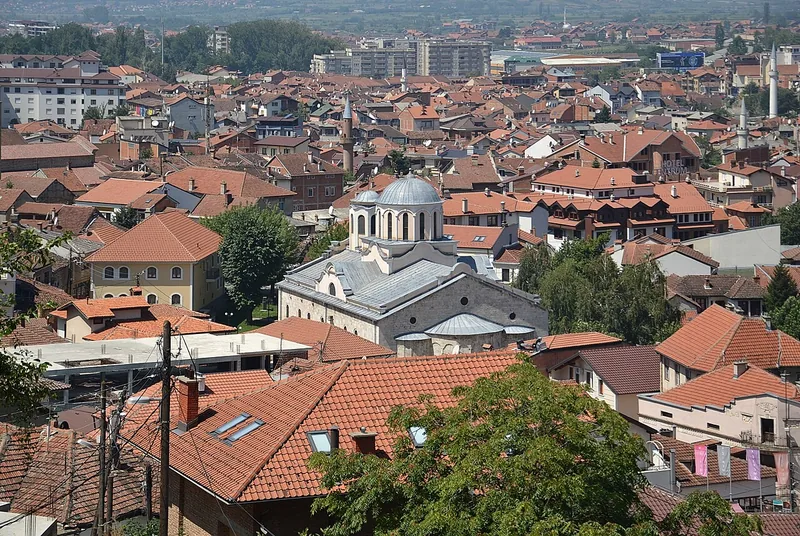
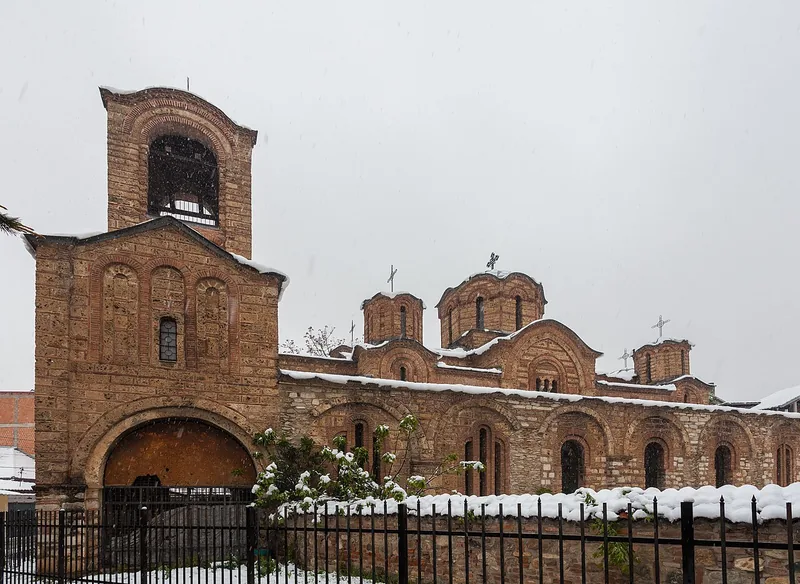
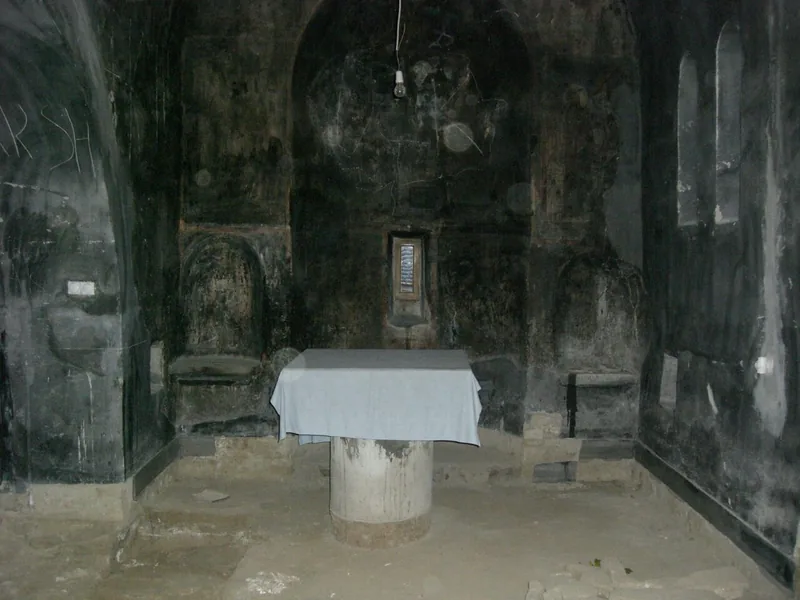
The Church of the Holy Virgin of Ljeviš (Bogorodica Ljeviška) in Prizren, dedicated to the Dormition of the Mother of God, is a royal foundation of Serbian King Stefan Uroš II Milutin built in 1306–1307 over the remains of an earlier 11th-century Byzantine three-aisled basilica and the medieval seat of the Bishopric of Prizren. Listed as item #01 in the May 2009 catalogue of the Reconstruction Implementation Commission (RIC), it was inscribed in July 2006 on the UNESCO World Heritage List as part of the serial property Medieval Monuments in Kosovo (#724bis) and on the List of World Heritage in Danger.


Historical and Architectural Significance
Situated in the historic core of Prizren, the Church of the Holy Virgin of Ljeviš served for centuries as the cathedral church of the bishops of Prizren. According to the archived dossier of the Reconstruction Implementation Commission (RIC) and UNESCO nomination records, the extant edifice was erected at the beginning of the 14th century (1306–1307) through a comprehensive reconstruction of an older 11th-century three-aisled Byzantine basilica, which had itself undergone restoration in the first half of the 13th century under King Stefan the First-Crowned. The early 14th-century reconstruction was commissioned by Serbian King Stefan Uroš II Milutin with the participation of Bishops Damjan and Sava of Prizren, and executed by master builder Protomaster Nikola, whose name is recorded in the historical brick inscription on the eastern facade.
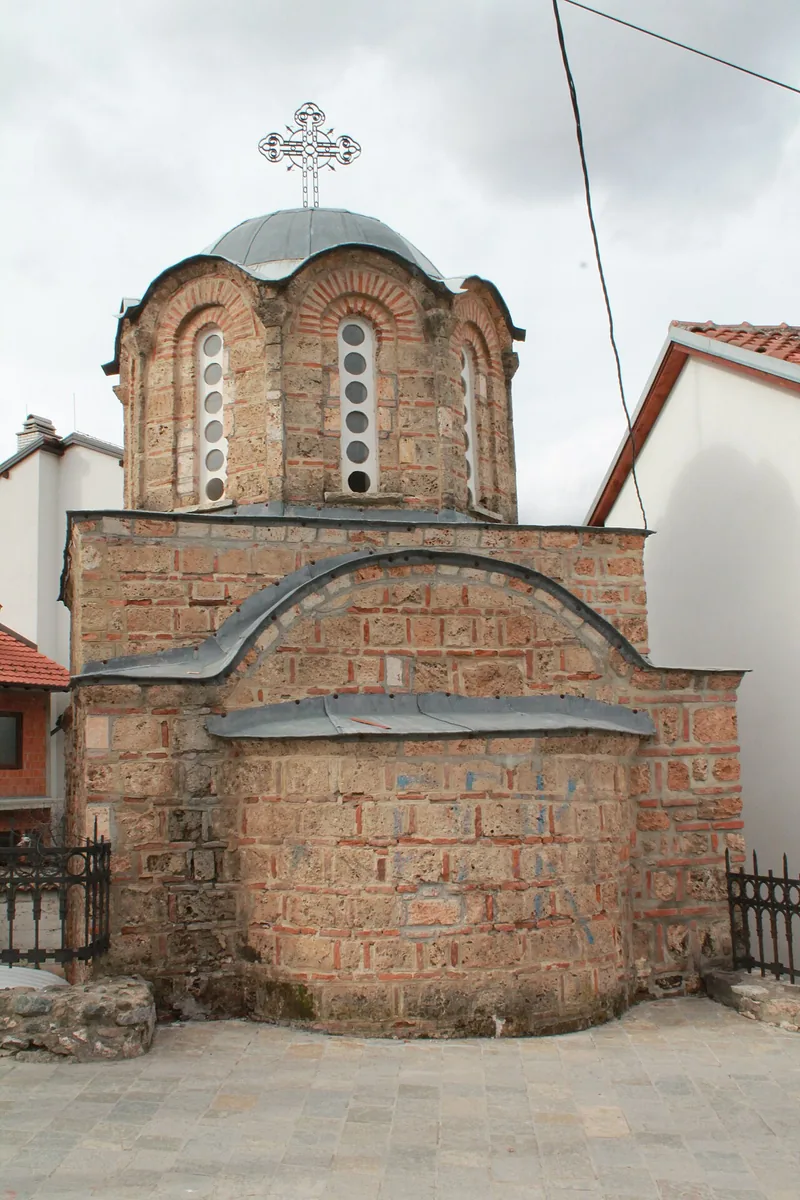
Architecturally, King Milutin's reconstruction transformed the central core of the earlier basilica into a five-domed cross-in-square church while incorporating lateral aisles and adding a two-storey outer narthex (exonarthex) on the west, surmounted by an axial belfry over the main entrance. Constructed in the Late Byzantine cloisonné technique using alternating courses of dressed tufa stone and brick, the facades feature rich ceramoplastic ornamentation, arcades, and two-light windows (biforia). During the Ottoman period, the church was converted into a mosque (known locally as the Cuma Mosque), at which time its medieval frescoes were covered with plaster and whitewash. Returned to Christian worship in the first half of the 20th century, the church underwent major architectural conservation and the uncovering of its frescoes in the early 1950s.
The wall paintings of Bogorodica Ljeviška represent a landmark of the early Palaiologan Renaissance in Byzantine and Serbian medieval art. While surviving fragments from the first half of the 13th century include depictions of the Wedding at Cana, the Healing of the Blind, and the Virgin Eleousa (Virgin of Tenderness) holding Christ the Provider of Prizren, the principal cycle of frescoes was painted between 1307 and 1313 by a workshop from Thessaloniki led by Protomaster Michael Astrapas. Alongside liturgical scenes, feast cycles, and figures in the five domes, the narthex houses a monumental portrait gallery of the Nemanjić dynasty and the bishops of Prizren. Recognized for its outstanding universal value, the monument was inscribed on the UNESCO World Heritage List in 2006 as an extension to the Visoki Dečani property (together with the Patriarchate of Peć and Gračanica Monastery) and simultaneously placed on the List of World Heritage in Danger.
Destruction and Recorded Damage (March 2004)
During the March 2004 unrest (17–18 March 2004), the Church of the Holy Virgin of Ljeviš suffered severe fire and vandalism damage. According to the 2004 Damage Assessment section of the archived RIC site dossier, a fire set inside the building affected the altar, nave, and exonarthex. Door and window openings were damaged, and the structural stability of the belfry was endangered by intense heat, particularly in the area of the stone biforium where the stone pillar and capital were compromised and structural timber beams of the belfry were burned.
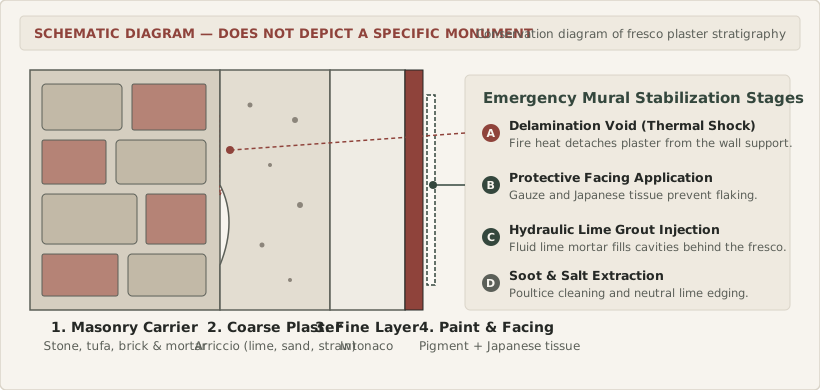
The fire and deliberate physical attacks caused severe degradation to the 13th- and 14th-century frescoes. Heavy smoke from burning tires and other materials deposited a thick layer of soot across the wall paintings, while thermal shock caused plaster delamination, blistering, and pigment alteration. The RIC damage assessment explicitly records targeted mechanical destruction: part of the 13th-century fresco of the Virgin Eleousa was destroyed by hammering. Furthermore, the RIC dossier records a subsequent post-2004 incident, noting that a large portion of the church's lead roof covering was stolen in 2005, exposing the vaults and fire-weakened frescoes to rainwater infiltration.
Reconstruction and Conservation Works (2005–2009)
Interventions under the mandate of the Reconstruction Implementation Commission (RIC) at the Church of the Holy Virgin of Ljeviš were executed in multiple stages between 2005 and 2008, alongside UNESCO heritage protection programmes initiated after the monument's 2006 World Heritage inscription. The table below summarizes the documented phases based on the archived RIC dossier and annual tender lists.
| Year | Completed Works and Interventions | Stage Status |
|---|---|---|
| 2005 | General clearance of the site; installation of a new fence and gates; replacement or repair of damaged doors, lintels, grills, and windows; replacement of the stone pillar and capital of the biforium; new timber construction covered with lead up to the first level of the belfry; replacement of burnt beams in the belfry and stabilization of the bell; installation of temporary plastic sheet covering over roof areas stripped of lead. | Completed |
| 2006 | Replacement of the lead roof cover over the lateral aisles, altar area, and belfry; stone and brickwork consolidation; repairs to damaged surfaces in the exonarthex; repair of the belfry's iron railings and reconstruction of the platform; repair of the upper gallery, render, and floors of the chapel; replacement of burnt joinery and lintels; reconstruction of the narthex timber gallery and staircase; window glazing. | Completed |
| 2007 | Full reconstruction of the auxiliary services building in the church compound; third phase of lead roof replacement. | Continued |
| 2008 | Continuation of works initiated in 2007. | Continued |
| 2009 | Reconstruction of the priest's house; wall paintings conservation programme; UNESCO programme. | Planned |
A close reading of the archived RIC records highlights a clear operational distinction between structural-architectural rehabilitation and specialist fresco conservation. Between 2005 and 2008, the RIC mechanism executed a sequence of civil and architectural contracts that stabilized the fire-damaged belfry and stone biforium, replaced burnt structural timber and the narthex gallery, consolidated stone and brick masonry, reconstructed the auxiliary services building (tender 43000-07-004-5-2-1), and carried out three successive phases of lead roof replacement (including tenders 43000-06-001-5-2-1, 43000-06-010-5-2-1, and 43000-07-019-5-2-1) to halt water penetration caused by the 2004 fire and the 2005 lead theft.
By contrast, the complex process of soot removal, plaster re-adhesion, and conservation of the medieval frescoes is recorded in the May 2009 RIC dossier strictly under 2009-Further interventions programmed, alongside the reconstruction of the priest's house and the broader UNESCO programme. Although the 2007 RIC tender list includes restricted tender 43000-07-006-5-2-2 (Wall paintings restoration in 10 Serbian Orthodox Churches), the RIC site sheet up to May 2009 does not report completed fresco conservation at Bogorodica Ljeviška.
Conservation Context and Monument Condition
According to the Commission's May 2009 documentation, That primary record confirms the completion of the 2005 protective interventions and the 2006–2008 architectural and roofing works, while leaving the priest's house reconstruction and wall paintings conservation in the status of programmed activities.
Subsequent UNESCO State of Conservation reports for Medieval Monuments in Kosovo (#724bis), as well as Council of Europe and OSCE reports from 2010–2011, document that multi-phase fresco conservation campaigns were conducted in later years under international and UNESCO-coordinated frameworks.
Frequently Asked Questions
Why does the Church of the Holy Virgin of Ljeviš appear on both the RIC list and the UNESCO World Heritage List?
Bogorodica Ljeviška is the only one of the four components of the UNESCO serial property 'Medieval Monuments in Kosovo' (#724bis) that was also part of the RIC's operational mandate for the 34 sites damaged in March 2004. While Visoki Dečani, the Patriarchate of Peć, and Gračanica were not on the RIC's March 2004 reconstruction list, Bogorodica Ljeviška suffered severe fire and vandalism damage in March 2004; consequently, its 2005–2008 structural and roofing rehabilitation was managed through the RIC mechanism alongside UNESCO's post-2006 heritage programmes.
What specific damage to the frescoes of Bogorodica Ljeviška is recorded in the RIC archive?
The 2004 Damage Assessment in the archived RIC dossier states that the interior was burnt and vandalized, the wall paintings were covered in soot, and part of the 13th-century fresco of the Virgin Eleousa (Virgin of Tenderness) was destroyed by hammering.
Why did the lead roof of Bogorodica Ljeviška require three phases of replacement between 2005 and 2007?
According to the explicit note in the RIC dossier, in addition to the March 2004 fire damage, a large part of the lead roof covering was stolen in 2005. In response, RIC installed lead covering on the first level of the belfry and temporary plastic sheeting over stripped roof areas in 2005, followed by dedicated lead roof replacement contracts in 2006 (43000-06-001-5-2-1) and 2007 (43000-07-019-5-2-1).
Which RIC tenders specifically reference the Church of the Holy Virgin of Ljeviš?
Five tender entries in the archived RIC records specifically name this monument: item #6 on the 2005 tender list, two contracts in 2006 (43000-06-001-5-2-1 for reparation of the lead roof and 43000-06-010-5-2-1 for restoration works in the church), and two contracts in 2007 (43000-07-004-5-2-1 for reconstruction of the auxiliary building and 43000-07-019-5-2-1 for lead roof works).
Does the May 2009 RIC dossier confirm the completion of wall painting conservation at Bogorodica Ljeviška?
No. As of May 2009, the wall paintings conservation programme, the reconstruction of the priest's house, and the UNESCO programme are listed under '2009-Further interventions programmed', indicating planned rather than completed works within that record.
Sources and Further Reading
- EU/CoE Support to the Promotion of Cultural Diversity in Kosovo (PCDK) & Previous Reconstruction Action — Council of Europe (Directorate of Culture and Cultural and Natural Heritage) (2010–2014) · Source document ↗
- Report Submitted by UNMIK Pursuant to Article 2.2 of the Agreement Between UNMIK and the Council of Europe Related to the Framework Convention for the Protection of National Minorities (ACFC/SR/II(2009)002) — Council of Europe / UNMIK (31. maj 2010.) · Source document ↗
- OSCE Mission in Kosovo Report on Cultural Heritage Protection and Reconstruction Process (Document 74597) — OSCE Mission in Kosovo (2008–2010) · Source document ↗
- Medieval Monuments in Kosovo (UNESCO World Heritage List Ref. 724bis) — UNESCO World Heritage Centre (2004 / 2006) · Source document ↗
- RIC Archival Page: The Background / Uvod — Reconstruction Implementation Commission (RIC) — archival snapshot (17. maj 2009.)