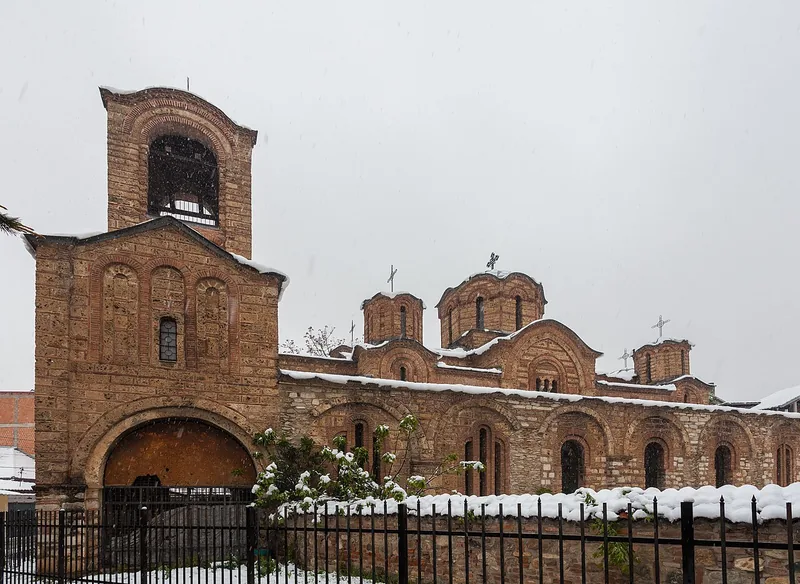
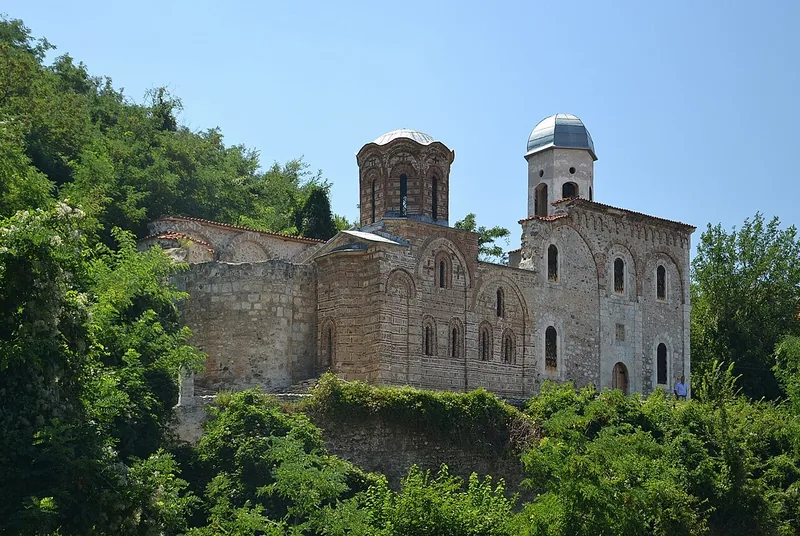
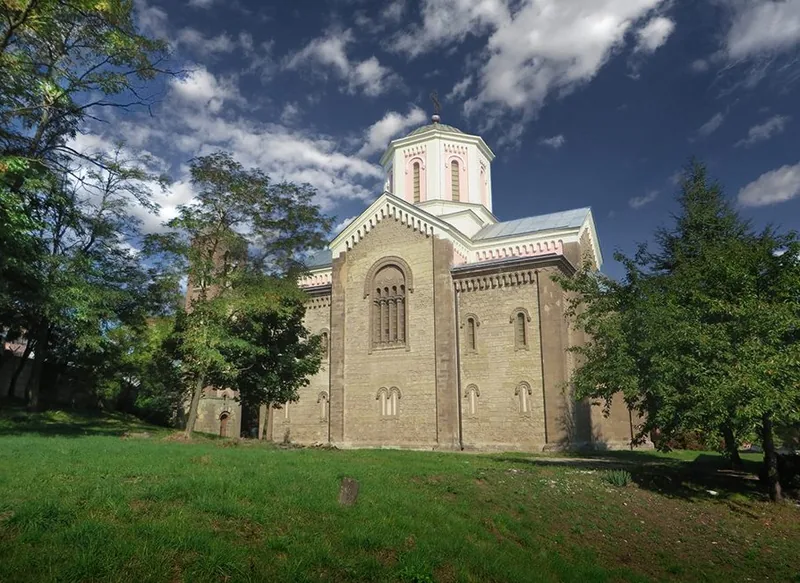
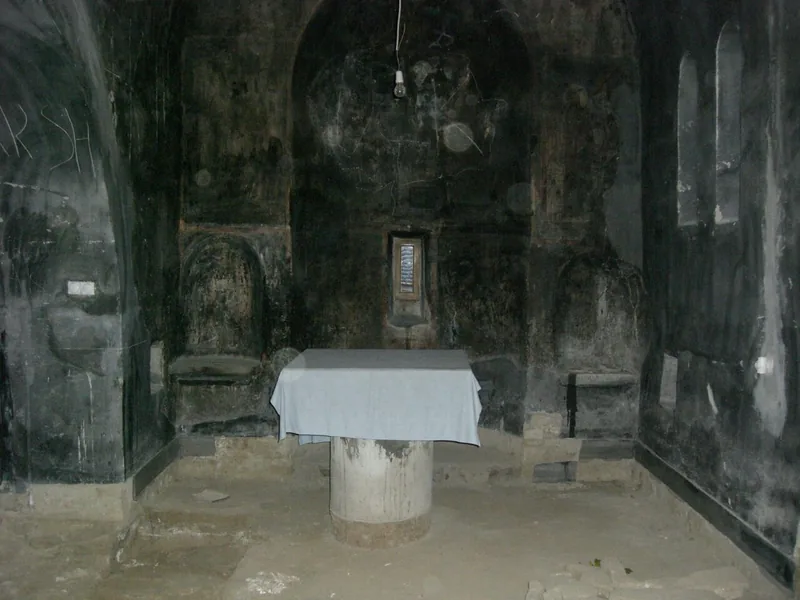
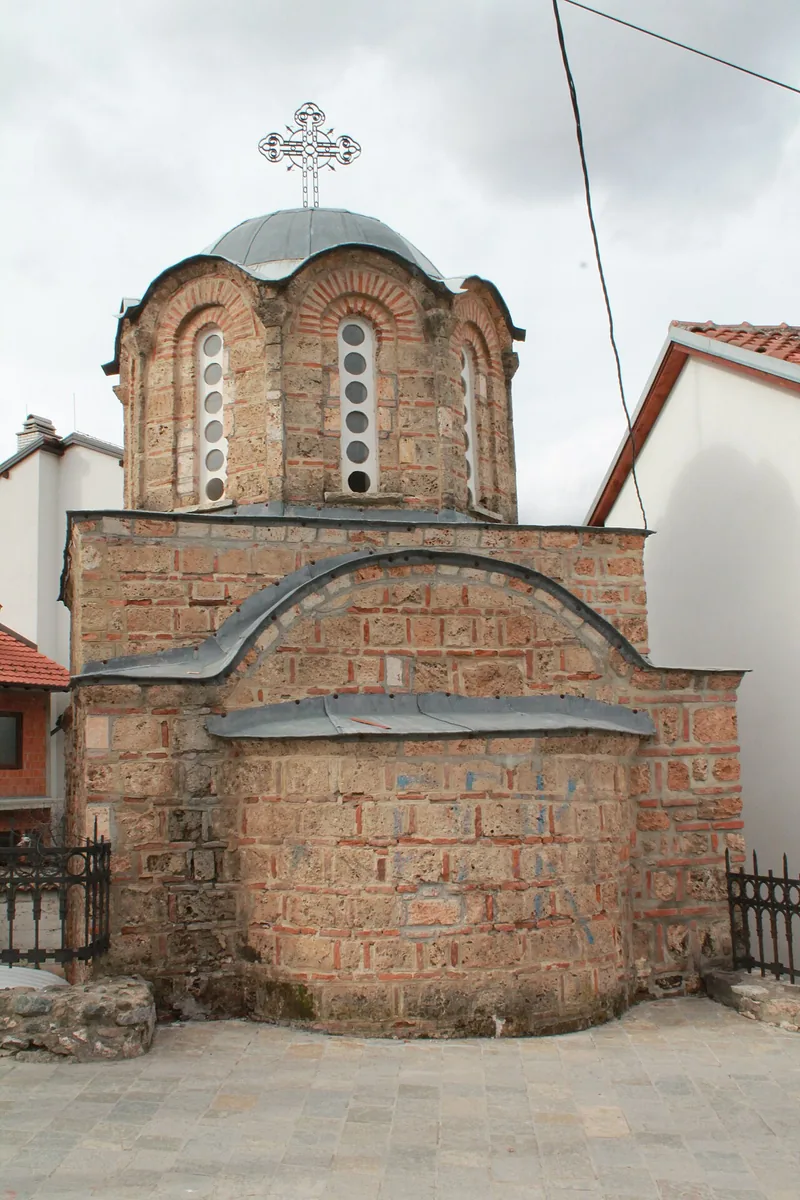
The UNESCO World Heritage property Medieval Monuments in Kosovo (entry #724bis) comprises four monastic and ecclesiastical components: Dečani Monastery (inscribed in 2004) and the Patriarchate of Peć Monastery, Gračanica Monastery, and the Church of the Virgin of Ljeviša in Prizren (added via serial extension in 2006, when the entire property was also placed on the List of World Heritage in Danger). By contrast, the Reconstruction Implementation Commission (RIC) held a specific mandate for 34 Serbian Orthodox religious sites damaged or destroyed in March 2004. The Church of the Holy Virgin Ljeviška in Prizren (#01) is the sole monument belonging simultaneously to both the four-site UNESCO World Heritage property and the 34-site RIC reconstruction programme.
The four UNESCO World Heritage components (#724bis) versus the 34 RIC mandate sites
Public commentary and secondary literature frequently confuse the scope of UNESCO World Heritage protection in Kosovo with the post-2004 reconstruction programme overseen by the Council of Europe-chaired Reconstruction Implementation Commission (RIC). Accurate documentary analysis requires separating the permanent international protection regime of the 1972 UNESCO World Heritage Convention from the targeted post-conflict recovery mandate of the RIC.
World Heritage inscription is governed by the criterion of Outstanding Universal Value. Dečani Monastery was inscribed on the World Heritage List in 2004 under reference 724. In 2006, the World Heritage Committee approved a serial extension (724bis) under the title Medieval Monuments in Kosovo, adding three further masterpieces of Palaiologan and Serbian medieval ecclesiastical architecture and mural painting: the Patriarchate of Peć Monastery, Gračanica Monastery, and the Church of the Virgin of Ljeviša in Prizren. In the same 2006 session, citing security and conservation vulnerabilities, the Committee inscribed the four-component property on the List of World Heritage in Danger.
Conversely, the RIC’s 34-site mandate was defined not by medieval date or World Heritage status, but by the specific emergency assessment of Serbian Orthodox religious sites damaged or destroyed during the March 2004 riots. Consequently, the RIC list spans 14th- and 15th-century medieval foundations (Our Lady of Ljeviš #01, Holy Archangels #02, Devič Monastery #03, Tutić’s Church #05, St Saviour #06, Presentation of the Virgin in Lipljan/Lipjan #31), major 19th-century urban cathedrals and seminary complexes (#04, #08, #09, #10, #12), and 20th-century parish churches, chapels, and cemeteries. Because Dečani, the Patriarchate of Peć, and Gračanica were not burned or demolished in March 2004 so as to fall under the 34-site emergency reconstruction list, they were not part of the RIC operational catalogue—making the Church of the Holy Virgin Ljeviška (#01) the single direct intersection between the two lists.
| Monument / Complex | UNESCO World Heritage Status (#724bis) | RIC Mandate and Catalogue Status (34 Sites) | Documented Notes in 2004–2009 Records |
|---|---|---|---|
| Dečani Monastery | Inscribed 2004 (In Danger since 2006) | Not among the 34 RIC reconstruction sites | Mentioned in a 24 Nov 2005 RIC press release recording an SRSG visit to Dečani and Prizren churches. |
| Patriarchate of Peć Monastery | Inscribed by extension in 2006 (In Danger since 2006) | Not among the 34 RIC sites (in Peć/Pejë, RIC covered #22 St John the Baptist & #23 Belo Polje) | Protected under the UNESCO World Heritage framework and competent monument institutes. |
| Gračanica Monastery | Inscribed by extension in 2006 (In Danger since 2006) | Not among the 34 RIC reconstruction sites | Venue of 2010 and 2011 meetings between Bishop Teodosije and the UNMIK SRSG discussing the RIC mechanism. |
| Church of the Holy Virgin Ljeviška, Prizren | Inscribed by extension in 2006 (In Danger since 2006) | Catalogue entry #01 in the RIC programme | The sole monument in both frameworks; RIC executed emergency protection and three lead-roof phases in 2005–2007. |
| Remaining 33 Serbian Orthodox RIC sites | Not part of UNESCO World Heritage property #724bis | Catalogue entries #02–#27 and #29–#35 | Four additional RIC dossiers (#06, #09, #31, #33) cite UNESCO programme under 2009 programmed works. |
UNESCO’s broader role after March 2004 and why 'UNESCO programme' appears in five 2009 RIC dossiers
While only four monuments belong to World Heritage entry #724bis, UNESCO’s technical involvement in Kosovo after March 2004 was broader than the World Heritage List alone. As recorded in, immediately after the March 2004 riots UNMIK invited UNESCO, the European Commission, and the Council of Europe to conduct damage assessments. Whereas the Council of Europe and the European Commission assumed operational responsibility for the May–July 2004 joint technical assessment missions and the creation of the RIC mechanism for the 34 sites, UNESCO also organised expert missions, international donor conferences, and dedicated bilateral conservation funds for endangered cultural heritage in Kosovo.
This parallel project activity explains why the May 2009 RIC site dossiers contain the specific entry UNESCO programme (UNESCO program) under the final section 2009 - FURTHER INTERVENTIONS PROGRAMMED across five different monuments. Alongside the World Heritage-listed Church of the Holy Virgin Ljeviška in Prizren (#01), the note UNESCO programme appears in four additional RIC dossiers that are not on the World Heritage List: (1) Church of Saint Saviour in Prizren (#06), a 14th-century domed church with surviving medieval frescoes; (2) Church of St Sava in Kosovska Mitrovica (#09), a late 19th-century domed church; (3) Church of the Presentation of the Virgin in Lipljan/Lipjan (#31), a 14th-century barrel-vaulted church with an integral stone iconostasis and wall paintings; and (4) Church of St Michael in Štimlje/Shtime (#33), an early 20th-century church.
Across all four non-World Heritage dossiers (#06, #09, #31, and #33), the chronological pattern is identical: the RIC executed Phase 1 emergency protective works in 2005 (site clearance, roof or joinery repairs, and perimeter fencing), recorded No interventions carried out for 2006, 2007, and 2008, and then listed UNESCO programme under 2009 programmed interventions. In doing so, the RIC Technical Unit recorded that subsequent conservation works on those monuments were scheduled under separate UNESCO-managed donor projects rather than through the RIC’s own MCYS/CoE procurement budget.
Documented case study from RIC records: Our Lady of Ljeviš (#01) between RIC structural recovery and UNESCO inscription
The RIC dossier for the Church of the Holy Virgin Ljeviška in Prizren (#01) illustrates how RIC field works and UNESCO status intersected on the ground. Its architectural header explicitly notes: 'Cultural historic monument, protected by law. Recently included in UNESCO world heritage list'. Following the March 2004 fire—which endangered the belfry around the biforium, burned the interior, coated the 14th-century frescoes in soot, and damaged the fresco of the Virgin Eleousa by hammering—and after a large section of the lead roof was stolen in 2005, the RIC carried out three consecutive seasons of structural and architectural recovery: in 2005 it replaced the stone pillar and capital of the biforium, stabilised the bell and burnt belfry beams, and installed temporary plastic sheet roofing; in 2006 (tenders 43000-06-001-5-2-1 and 010-5-2-1) it consolidated the stone and brick masonry, replaced the lead roof over the lateral aisles, altar, and belfry, and reconstructed the narthex timber gallery; and in 2007–2008 (tenders 43000-07-004-5-2-1 and 019-5-2-1) it completed the third phase of lead roof replacement and fully reconstructed the auxiliary services building. Under 2009 - Further interventions programmed, the dossier then lists reconstruction of the priest’s house, a wall paintings conservation programme, and UNESCO programme.
Frequently Asked Questions
Which monuments belong to the UNESCO World Heritage property 'Medieval Monuments in Kosovo' (#724bis)?
The property comprises four monuments: Dečani Monastery (inscribed in 2004) and the Patriarchate of Peć Monastery, Gračanica Monastery, and the Church of the Virgin of Ljeviša in Prizren (added by serial extension in 2006, when all four were also placed on the List of World Heritage in Danger).
Why are Dečani, the Patriarchate of Peć, and Gračanica not on the RIC's 34-site list?
Because the RIC's mandate was restricted to the 34 Serbian Orthodox religious sites assessed as damaged or destroyed during the March 2004 riots; among the four UNESCO World Heritage components, the Church of the Holy Virgin Ljeviška in Prizren (#01) was the one severely burned in March 2004.
Why do the dossiers for St Saviour (#06) and Lipljan (#31) mention 'UNESCO programme' if they are not World Heritage sites?
In addition to monitoring World Heritage property #724bis, UNESCO coordinated separate donor-funded conservation projects for other damaged monuments in Kosovo; the 2009 RIC dossiers for sites #01, #06, #09, #31, and #33 note UNESCO programme to indicate that follow-up works there fell under UNESCO project channels.
What works did the RIC directly carry out at the Church of the Holy Virgin Ljeviška (#01)?
Between 2005 and 2008, the RIC executed site clearance and fencing, replaced the belfry biforium pillar and capital, consolidated stone and brick masonry, completed three phases of lead roof replacement, reconstructed the narthex timber gallery, and rebuilt the auxiliary services building.
Sources and Further Reading
- EU/CoE Support to the Promotion of Cultural Diversity in Kosovo (PCDK) & Previous Reconstruction Action — Council of Europe (Directorate of Culture and Cultural and Natural Heritage) (2010–2014) · Source document ↗
- Report Submitted by UNMIK Pursuant to Article 2.2 of the Agreement Between UNMIK and the Council of Europe Related to the Framework Convention for the Protection of National Minorities (ACFC/SR/II(2009)002) — Council of Europe / UNMIK (31. maj 2010.) · Source document ↗
- UNMIK SRSG visits His Grace Bishop Teodosije in Gračanica Monastery — United Nations Interim Administration Mission in Kosovo (UNMIK) (31. maj 2011.) · Source document ↗
- Medieval Monuments in Kosovo (UNESCO World Heritage List Ref. 724bis) — UNESCO World Heritage Centre (2004 / 2006) · Source document ↗
- Episkopi Atanasije i Teodosije primili šefa UNMIK-a i komandanta KFOR-a u manastiru Gračanica — Diocese of Raška and Prizren (Serbian Orthodox Church) (2. mart 2010.) · Source document ↗
- RIC Archival Page: The Background / Uvod — Reconstruction Implementation Commission (RIC) — archival snapshot (17. maj 2009.)