In architectural heritage practice and the records of the Reconstruction Implementation Commission (RIC), conservation denotes the physical and chemical stabilisation of surviving original fabric in situ, restoration refers to the legible recovery of damaged architectural or artistic elements based on authentic evidence, and reconstruction designates the rebuilding of collapsed roofs, vaults, domes, or entire burned structures. Clarifying these exact distinctions was the opening topic of the five-day workshop hosted by the European Centre for Byzantine and Post-Byzantine Monuments (EKBMM) in Thessaloniki from 11 to 15 November 2007 for 18 local specialists nominated by the Belgrade and Pristina protection institutes.
Conservation philosophy in the 2007 IEB seminars and the Thessaloniki EKBMM workshop
Although the Commission’s institutional title used the broad term 'Reconstruction' (Reconstruction Implementation Commission), the works programmed between 2005 and 2009 spanned emergency protection, structural consolidation, architectural conservation, specialist restoration, and full building reconstruction. The archived page documents a systematic series of professional seminars organised in 2007 by the International Expert Board (IEB) and partner institutions to align site methodologies with European conservation conventions.
On 18 September 2007, architect Pedro Ponce de Leon (IEB) delivered a seminar on 'Introduction to "conservation philosophy"', followed on 20 September 2007 by archaeologist Demetrios Athanasoulis (IEB) on 'Introduction to archaeology standards and principles', and on 17 October 2007 by structural engineer Michael Eatherley (IEB) on 'Principles of conservation of buildings from a structural perspective'. Earlier that summer, from 15 to 23 August 2007, archaeologist Ruben Thorpe of the Macedonian Centre for Archaeological Research conducted a nine-day field archaeological training course.
This training sequence culminated in a five-day workshop held from 11 to 15 November 2007 at the European Centre for Byzantine and Post-Byzantine Monuments (EKBMM) in Thessaloniki, attended by 18 local experts nominated by the Institutes for the Protection of Monuments in Belgrade and Pristina. As recorded in, the curriculum opened with Concept analysis: protection, restoration – conservation, reconstruction, followed by modules on methodology, international conventions, Restoration of the core of monuments: principles, methodology, application, Plaster techniques - infusions, and Conservation of wall paintings, stone and wood, alongside study visits to the laboratories of the Museum of Byzantine Culture in Thessaloniki and restored monuments in Chalkidike (St Stephanos of Arnea, the Tower of Ouranoupolis, Zygos Monastery, and the Basilica of Sophronius in Nikiti).
| Term (EN / SR) | Primary Technical Objective | Relationship to Original Fabric | Documented Example in RIC Dossiers and Tenders |
|---|---|---|---|
| Protective intervention / Hitna zaštita | Halt immediate environmental degradation and secure the site against intrusion | Reversible temporary roofing, scaffolding support, debris clearance, and perimeter fencing | Temporary metallic roof over scaffolding at St Nicholas in Pristina (#10) and temporary roof at St Elias in Vučitrn/Vushtrri (#08) in 2005. |
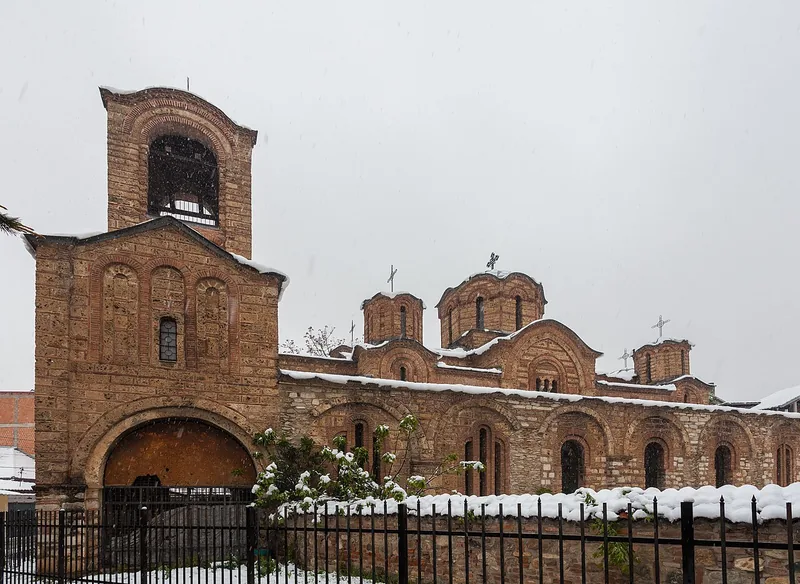
| Conservation / Konzervacija | Stabilise and preserve surviving authentic masonry, plaster, and paint layers | Retention of original stone, brick, mortar, and fresco layers via grouting and consolidation | Stone and brick work consolidation at Holy Virgin Ljeviška (#01) in 2006; consolidation of foundation remains at Bistražin (#25) in 2005. |
| Restoration / Restauracija | Recover structural and aesthetic legibility of damaged historical elements | Targeted replacement of missing architectural members (e.g. biforium shaft) and soot/lacuna treatment | Replacement of stone pillar and capital of the belfry biforium at Ljeviška (#01) and 2006 restoration contract at Runović's Church (#07). |
| Reconstruction / Rekonstrukcija | Rebuild collapsed vaults, domes, belfries, or burned auxiliary buildings | New structural construction matching historical geometry or archaeological and archival records | Rebuilding of stone vaults, dome, and belfry at St George Cathedral in Prizren (#04) and central konak at Devič Monastery (#03) in 2006–2007. |
Wall painting stratigraphy: why mortar grouting precedes surface cleaning
In Byzantine and post-Byzantine church architecture, wall paintings (frescoes) are not superficial coatings applied to a finished wall, but an integral multi-layered lime-plaster system bonded to the structural masonry core. As emphasised in the November 2007 Thessaloniki EKBMM modules (Restoration of the core of monuments, Plaster techniques - infusions, Conservation of wall paintings), any treatment of fire-damaged murals must address the entire cross-section of the wall.
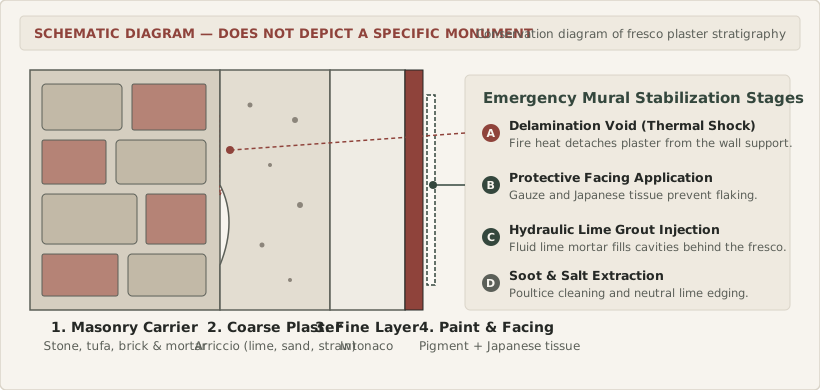
The educational schematic diagram on this page illustrates the four principal strata of a generic painted masonry wall: (1) the structural support (masonry core) of stone, tufa, or brick laid in lime mortar; (2) the coarse base render (arriccio), which levels the masonry surface and often incorporates organic fibres or crushed brick to regulate moisture and shrinkage; (3) the fine painting plaster (intonaco), a compact layer of aged slaked lime and fine sand or marble dust; and (4) the pigment layer, executed either al fresco on damp plaster—where carbonation locks mineral pigments into a crystalline calcium carbonate crust—or completed with al secco details over the dried surface.
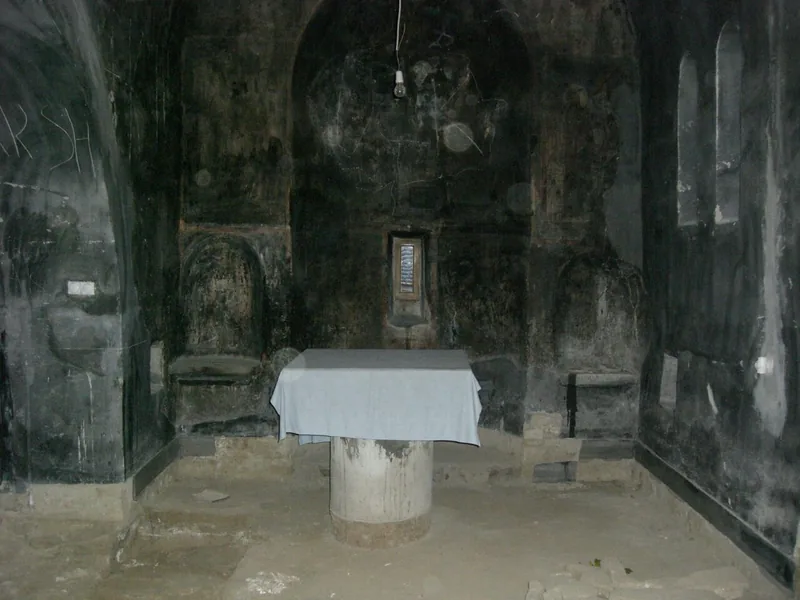
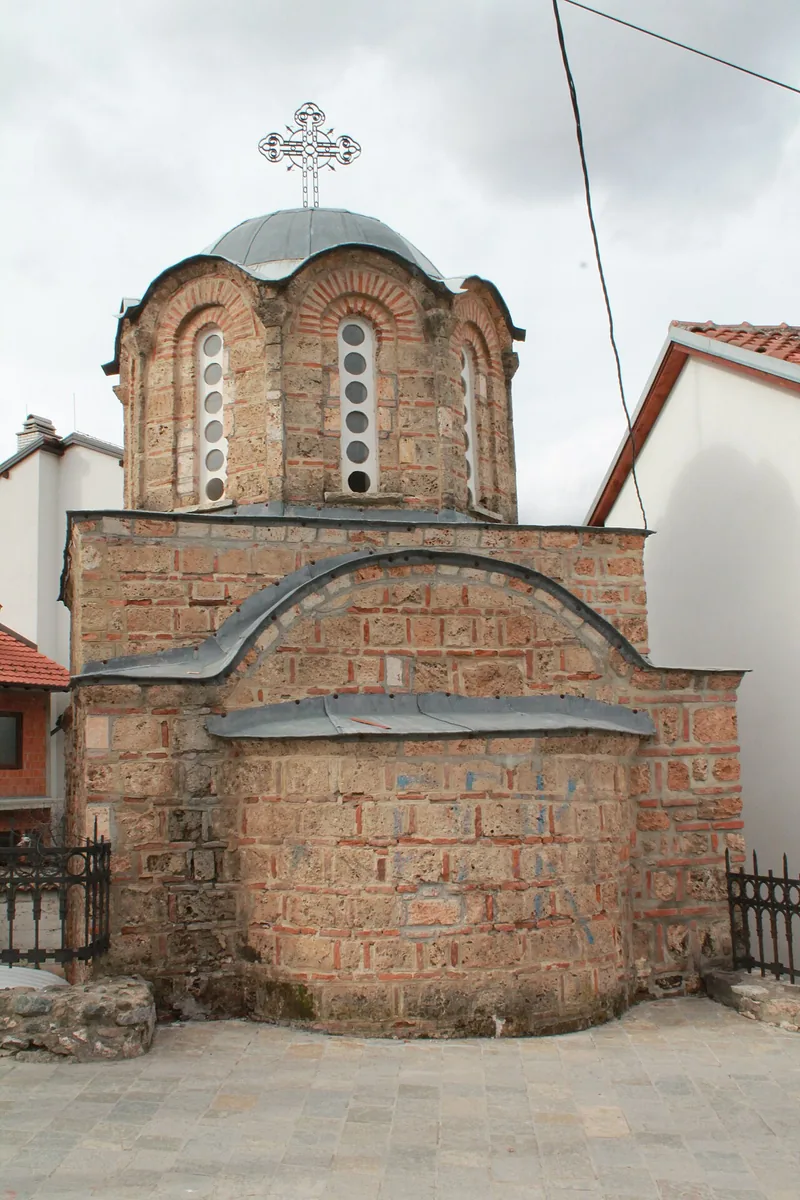
When intense fires burned inside vaulted churches in March 2004—as documented at Our Lady of Ljeviš (#01), Tutić’s Church (#05), St Saviour (#06), the Old Church of St George / Runović’s (#07), St Elias in Vučitrn/Vushtrri (#08), St Nicholas in Pristina (#10), and Devič Monastery (#03)—thermal shock caused trapped moisture to vaporise, detaching the arriccio and intonaco from the masonry support, while dense smoke deposited greasy soot across the paint surface and high heat altered mineral pigments (such as transforming yellow ochre into red iron oxide). Consequently, conservation methodology required weatherproofing the roof and drying the masonry first, injecting compatible hydraulic lime grouts (infusions) behind detached plaster pockets and edging losses second, and only then performing chemical and mechanical soot removal on the painted surface.
How the terms were applied in the 2006 and 2007 RIC tender notices
An examination of confirms that the RIC Technical Unit deliberately distinguished between Reconstruction works and Restoration works in official contract titles. Where roofs, vaults, domes, or residential buildings had collapsed completely, the 2006 contracts were titled Reconstruction works: notably 43000-06-002-5-1-1 (Reconstruction works in St George Cathedral. Prizren), 43000-06-003-5-1-1 (Reconstruction works in St Nicholas Church. Pristina), and 43000-06-004-5-2-1 / 011-5-2-1 for Devič Monastery and its central konak.
Conversely, where authentic medieval or 19th-century masonry vaults survived and required specialist architectural conservation and repair, the 2006 contracts were formally titled Restoration works: 43000-06-007-5-2-1 (Restoration works in the Church of the Presentation of the Virgin in Belo Polje), 43000-06-008-5-2-1 (Restoration works in the Old Church of St George (Runovic). Prizren), 43000-06-009-5-2-1 (Restoration works in the Church of St Elias in Vushtrri/Vucitrn), and 43000-06-010-5-2-1 (Restoration works in the Church of the Holy Virgin Ljeviska. Prizren). In 2007, specialist artistic conservation was separated into restricted procurement procedures (43000-07-006-5-2-2 (restricted): Wall paintings restoration in 10 Serbian Orthodox Churches), ensuring that mural treatment was reserved for qualified conservation teams.
Documented case study from RIC records: combining protection, conservation, reconstruction, and restoration at Devič Monastery (#03)
The RIC dossier for the Monastery of St Joanikije at Devič (#03) illustrates how all four technical categories operated within a single complex between 2005 and 2009. In 2005, the RIC carried out Protective Interventions: repairing perimeter walls, fixing the church lead roof and gutters, repairing the altar table, and demolishing an unstable partition wall in the old konak. In 2006 and 2007, work on the monastic residences combined structural conservation (Walls consolidation and reinforcement on surviving masonry) with architectural reconstruction (New concrete slabs, New roof construction and roof tiles, partitions, services, and a new boiler house). Meanwhile, for the 15th-century monastery church—whose 15th- and 19th-century frescoes were covered in soot and graffiti—Wall paintings restoration and a New iconostasis were programmed as separate specialist interventions under the 2009 heading.
Frequently Asked Questions
What is the main difference between conservation and reconstruction in RIC documentation?
Conservation preserves and consolidates surviving authentic masonry, plaster, and paint layers in situ, whereas reconstruction involves rebuilding collapsed structural elements such as domes, roofs, vaults, or burned residential konaks.
Who hosted the five-day conservation workshop in November 2007?
From 11 to 15 November 2007, the European Centre for Byzantine and Post-Byzantine Monuments (EKBMM) in Thessaloniki hosted a five-day workshop for 18 local specialists nominated by the Institutes for the Protection of Monuments in Belgrade and Pristina.
Which International Expert Board (IEB) members led training seminars in autumn 2007?
The archived page records seminars by architect Pedro Ponce de Leon (18 September 2007), archaeologist Demetrios Athanasoulis (20 September 2007), and structural engineer Michael Eatherley (17 October 2007), following field archaeological training by Ruben Thorpe in August 2007.
Why was wall painting restoration tendered separately from general building works?
Fire-damaged murals require stable microclimatic conditions (completed roofs, glazing, and dried masonry) and specialist conservation-restoration credentials, which is why the RIC issued separate restricted tenders such as 43000-07-006-5-2-2 in 2007.
Sources and Further Reading
- EU/CoE Support to the Promotion of Cultural Diversity in Kosovo (PCDK) & Previous Reconstruction Action — Council of Europe (Directorate of Culture and Cultural and Natural Heritage) (2010–2014) · Source document ↗
- Report Submitted by UNMIK Pursuant to Article 2.2 of the Agreement Between UNMIK and the Council of Europe Related to the Framework Convention for the Protection of National Minorities (ACFC/SR/II(2009)002) — Council of Europe / UNMIK (31. maj 2010.) · Source document ↗
- RIC Archival Page: The Background / Uvod — Reconstruction Implementation Commission (RIC) — archival snapshot (17. maj 2009.)
- RIC Archival Site Dossiers (/inc/{eng,srp}/sites/*.html, May–July 2009) — Reconstruction Implementation Commission (RIC) — archival snapshots (17. maj 2009. / 28. jul 2009.)