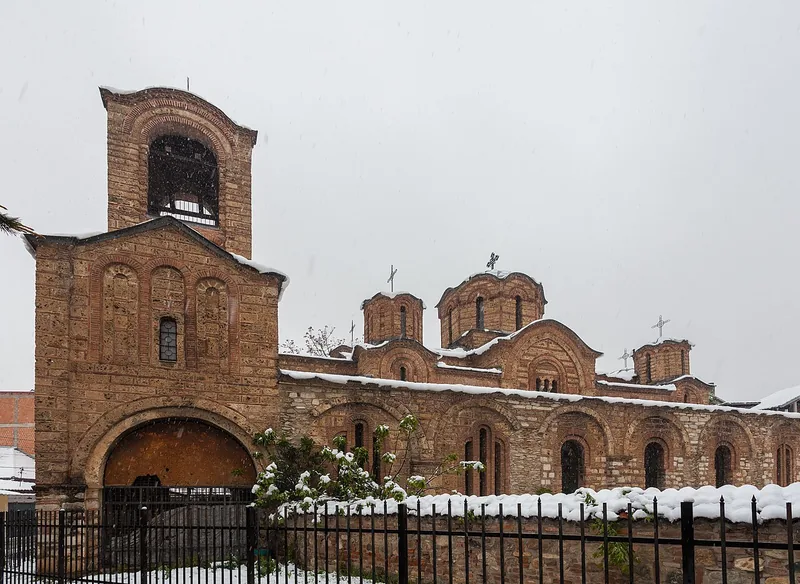
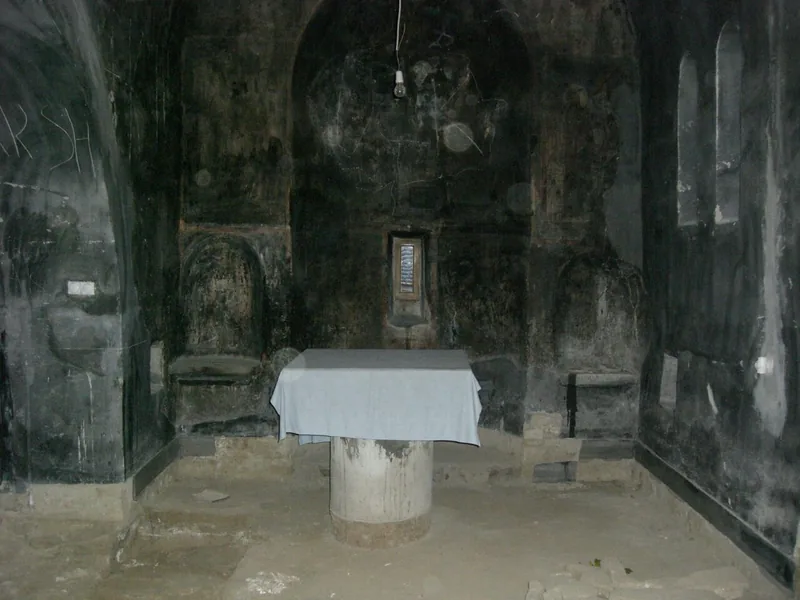
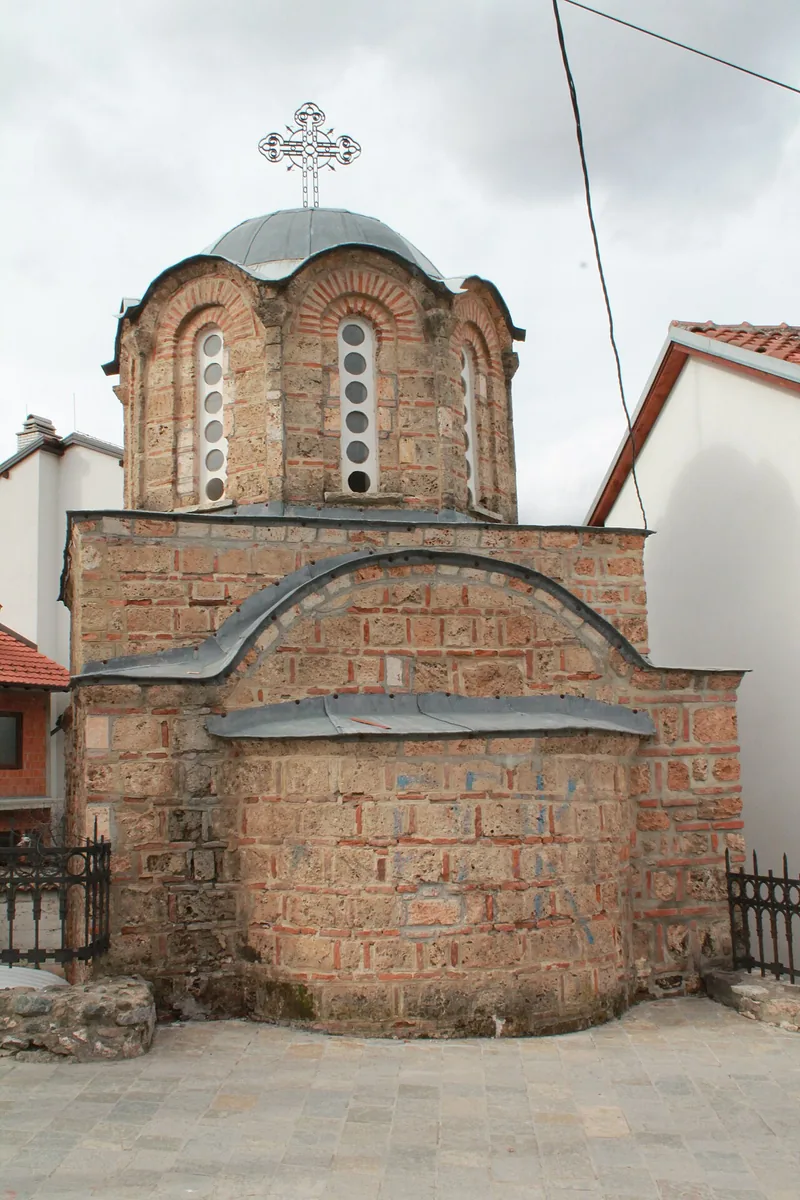
The first operational phase executed by the Reconstruction Implementation Commission (RIC) in autumn and winter 2005 comprised emergency protective interventions (Protective Interventions) across 30 sites organised into 16 tender groups. Its primary objective was to weatherproof and stabilise burned or blasted structures before winter: installing temporary metallic or plastic roofs and permanent lead coverings, consolidating vaults and biforia, conducting archaeologically supervised debris sorting (as at Bistražin #25), and securing complex perimeters. Because fire-damaged murals require stable roofs, dried masonry, and controlled microclimates before surface treatment, wall painting restoration was withheld from the 2005 emergency phase and programmed separately in 2007–2009.
Scope of the 2005 emergency protective phase across 30 sites
By the time the RIC held its first plenary meeting in May 2005, thirty Serbian Orthodox churches, monasteries, and chapels on its mandate list had stood exposed to rain, snow, frost, and secondary thefts of metal roofing for over a year following the March 2004 riots. Consequently, the Commission’s immediate priority in autumn 2005 (documented in the 10 October, 2 November, and 21 December 2005 press releases on ) was executing rapid physical protection across all 30 accessible sites ahead of winter.
A cross-site review of the 2005 - Protective Interventions sections in the 2009 dossiers shows how protective engineering was tailored to each building’s structural condition. Where timber roofs and masonry vaults had collapsed entirely into the nave—as at St Nicholas Church in Pristina (#10, where only fire-damaged perimeter walls and the dome remained standing) and St Elias Church in Vučitrn/Vushtrri (#08)—contractors erected a temporary metallic roof construction over a scaffold (or protective temporary roof), which shielded the interior through the winter and was dismantled in 2006 when permanent pillars, vaults, and roofs were constructed. At the burned Episcopal Church of St George in Prizren (#04), 2005 works focused on mounting provisional scaffolding and temporary weather protection over the tops of the standing perimeter walls.
Where masonry vaults survived the fire but lead roofing had been stripped or damaged in 2004–2005—as at Tutić’s Church of St Nicholas (#05), Runović’s Old Church of St George (#07), St Kyriake in Prizren (#16), and Devič Monastery (#03)—the RIC carried out immediate re-roofing with lead or lead roof repairs in 2005, while at Our Lady of Ljeviš (#01) the first level of the belfry was re-roofed in lead and roof areas stripped by 2005 lead theft were covered with temporary plastic sheet roof covering pending the three-phase permanent lead roof replacement of 2006–2007.
| March 2004 Damage Category | 2005 Emergency Protective Intervention | Subsequent Phase (2006–2009) | Documented RIC Sites |
|---|---|---|---|
| Collapsed roof and vaults over burned church nave | Temporary metallic or timber roof over scaffolding; protection of exposed wall tops | Dismantling of temporary roof (2006), construction of new pillars, vaults, and permanent roof | St Nicholas in Pristina (#10), St Elias in Vučitrn/Vushtrri (#08), St George Cathedral in Prizren (#04). |
| Stripped or fire-damaged lead roof over intact masonry vaults | Direct re-roofing with lead sheet or temporary plastic sheet covering over stolen sections | Multi-phase replacement of permanent lead roof coverings (2006–2007) | Holy Virgin Ljeviška (#01), Devič Monastery (#03), Tutić's (#05), Runović's (#07, lead stolen in 2005 & 2006), St Kyriake (#16). |
| Structural instability in apse, barrel vault, or belfry biforium | Replacement of biforium stone pillar and capital; vault consolidation; rebuilding of blown-up apse | Internal plasterwork, marble flooring, joinery, and belfry reconstruction (2006–2007) | Holy Virgin Ljeviška (#01, biforium), St Andrew in Podujevo (#11, blown-up apse), Belo Polje (#23, vault). |
| Complete demolition by explosives or fire to foundation level | Selective removal of debris under archaeological supervision; on-site stone storage; foundation consolidation | Perimeter wall, parish/guest house reconstruction (2006–2007), and programmed church rebuild (2009) | St Elias in Bistražin (#25), Church of the Assumption in Đakovica/Gjakovë (#26). |
| Wall paintings damaged by fire, smoke, soot, and hammering | Closing building envelope (new oak doors, window glazing, or plexiglass) to stabilise interior microclimate | 2007 restricted tender for wall paintings in 10 churches and 2009 programmed conservation | #01, #03, #05, #06, #07, #08, #10, #16, #17, #23, #31, #33. |
Structural consolidation and archaeological supervision of debris (Bistražin #25, Podujevo #11, and Runović’s Church #07)
Emergency protection in 2005 extended beyond weatherproofing to include urgent structural rescues and archaeological recovery. At the Church of St Elias in Bistražin/Bishtrazhin near Đakovica/Gjakovë (#25), which had been blown up with explosives and completely destroyed in March 2004, the RIC avoided mechanical bulldozer clearance that would have erased architectural evidence. Instead, the 2005 dossier explicitly records: Selective removal of debris under the supervision of an archaeologist. Storage of reusable materials within the site. Consolidation of the foundation remains.
Comparable care was documented at the Old Church of St George — Runović’s Church in Prizren (#07), where an interior explosion and fire had cracked the masonry, damaged the medieval frescoes, and desecrated a tomb inside the church: the 2005 protective phase opened with a Cleanup operation with recovery of sensitive material and Protective covering of the floor and tombstone inside the church alongside temporary softwood doors and windows. At the Church of St Andrew in Podujevo/Podujevë (#11), whose eastern apse had been blown up with explosives in March 2004, the 2005 protective contract immediately executed the Reconstruction of the blown-up apse and roof repairs to close the structural shell before winter.
How fire affects wall paintings and why mural restoration was programmed separately (2007–2009)
The 2004 damage assessments across the RIC corpus record fire, smoke, soot, or mechanical damage to wall paintings at more than ten monuments: Our Lady of Ljeviš (#01, soot coverage plus hammering damage to the fresco of the Virgin Eleousa), Devič Monastery (#03, soot and graffiti over 15th- and 19th-century frescoes), Tutić’s Church (#05), St Saviour (#06), Runović’s Church (#07), St Elias in Vučitrn/Vushtrri (#08), St Nicholas in Pristina (#10), St Kyriake in Prizren (#16), St Nicholas in Kosovo Polje/Fushë Kosovë (#17), Sts Peter and Paul in Talinovac (#19), Presentation of the Virgin in Belo Polje (#23), and St Michael in Štimlje/Shtime (#33).
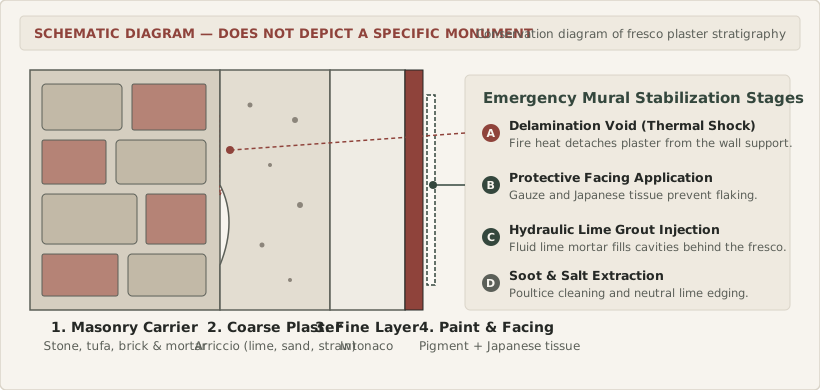
When timber iconostases, roof trusses, galleries (emporia), and furnishings burn inside a masonry church, mural paintings suffer three compounding forms of degradation: (1) deposition of dense, tarry soot across the porous lime plaster; (2) thermal calcination and pigment alteration (such as yellow ochre dehydrating into red iron oxide), accompanied by blistering and detachment of the arriccio and intonaco plaster layers from the stone substrate; and (3) rainwater infiltration and soluble salt mobilisation through breached roofs, causing efflorescence and powdering as the walls dry.
Because attempting surface cleaning on damp, detached plaster causes irreversible loss of original paint layers, standard conservation methodology requires completing roofs, rainwater drainage, and window glazing first so that the masonry core can dry and stabilise. Accordingly, the RIC restricted its 2005–2006 work on painted churches to closing the building envelope (installing oak doors and window glass, or plexiglass glazing as at Štimlje #33), issued a dedicated restricted tender (43000-07-006-5-2-2) in 2007 for Wall paintings restoration in 10 Serbian Orthodox Churches, and listed wall painting conservation under 2009 - FURTHER INTERVENTIONS PROGRAMMED across dossiers #01, #03, #05, #07, #08, #10, #16, #17, and #23.
Documented case study from RIC records: from 2005 temporary roofs to 2009 programmed mural restoration in Vučitrn/Vushtrri (#08) and Pristina (#10)
Comparing the RIC dossiers for the Church of St Elias in Vučitrn/Vushtrri (#08, erected in 1834 over 16th–17th century remains) and the Church of St Nicholas in Pristina (#10, an early 19th-century basilica) illustrates the four-stage recovery sequence after severe interior fires. In March 2004, both churches lost their roofs, timber galleries, and iconostases to fire, leaving their wall paintings scorched and exposed to the elements. In 2005, the RIC cleared debris, protected openings, and erected temporary protective roofs over both buildings (a metallic roof over scaffolding in Pristina). In 2006, the provisional roofs were dismantled, perimeter drainage was excavated, new structural pillars and roofs were built (stone roof covering over the nave and tiles over the exonarthex in Vučitrn; roof tiles over the nave and lead over the exonarthex in Pristina), and new joinery was fitted. In 2007–2008, works focused on the parish houses, belfries, and baptistery, leaving Wall paintings restoration and Iconostasis restoration / New iconostasis as the culminating specialist tasks programmed under 2009.
Frequently Asked Questions
Why did the RIC install temporary metallic or plastic roofs at several churches in 2005?
Where roofs and vaults had completely collapsed (such as St Nicholas in Pristina #10 and St Elias in Vučitrn/Vushtrri #08) or where lead sheeting had been stolen shortly before winter (such as sections of Our Lady of Ljeviš #01), temporary roofs provided immediate weatherproofing until full engineering designs and Phase 2 tenders were executed in 2006.
How did the RIC handle debris at churches demolished with explosives, such as Bistražin (#25)?
At St Elias in Bistražin (#25), the 2005 protective intervention involved selective removal of debris under the supervision of an archaeologist, on-site storage of reusable stone materials, consolidation of the surviving foundation remains, and perimeter fencing.
How many churches were included in the 2007 restricted tender for wall paintings restoration?
Restricted tender 43000-07-006-5-2-2 (restricted), issued in 2007, covered Wall paintings restoration in 10 Serbian Orthodox Churches.
Why must roof reconstruction and drainage precede soot removal on fire-damaged frescoes?
Fire detaches lime plaster layers (arriccio and intonaco) from the masonry core while rainwater mobilises destructive salts; until the building envelope is watertight, the walls dry out, and hollow plaster pockets are grouted, surface cleaning risks detaching the pigment layer.
Sources and Further Reading
- Report Submitted by UNMIK Pursuant to Article 2.2 of the Agreement Between UNMIK and the Council of Europe Related to the Framework Convention for the Protection of National Minorities (ACFC/SR/II(2009)002) — Council of Europe / UNMIK (31. maj 2010.) · Source document ↗
- RIC Archival Page: The Background / Uvod — Reconstruction Implementation Commission (RIC) — archival snapshot (17. maj 2009.)
- RIC Archival Site Dossiers (/inc/{eng,srp}/sites/*.html, May–July 2009) — Reconstruction Implementation Commission (RIC) — archival snapshots (17. maj 2009. / 28. jul 2009.)
- RIC Archival Page: Current Activities / Trenutne aktivnosti — Reconstruction Implementation Commission (RIC) — archival snapshot (april 2009.)